

 Illustration
North Georgia · Blue Ridge
What is Blue Ridge, Georgia known for?
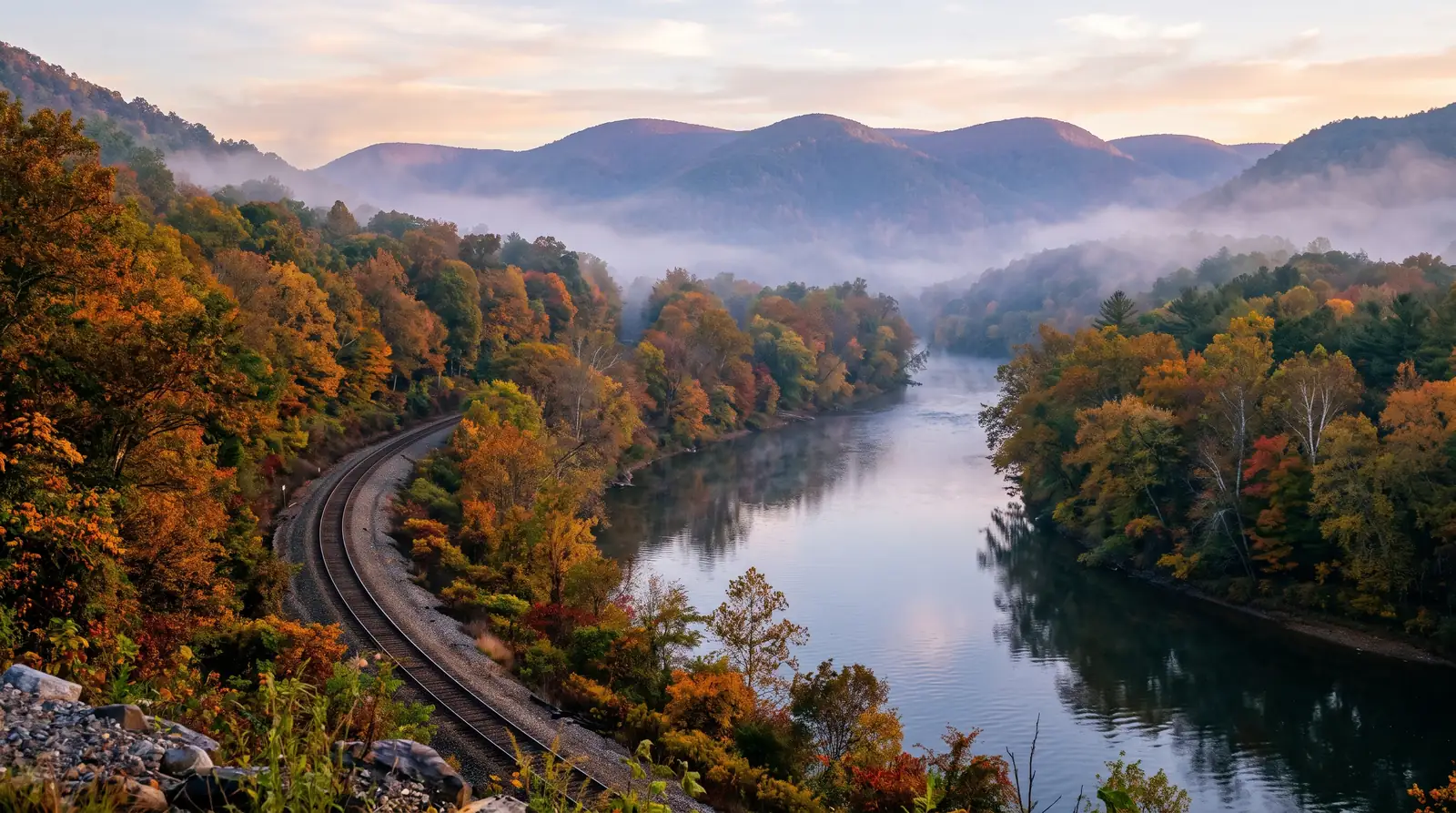
Blue Ridge is the Fannin County seat in the north Georgia mountains, known for the Blue Ridge Scenic Railway along the Toccoa River, a walkable downtown, Lake Blue Ridge, trout fishing, the Aska trails and Mercier Orchards, roughly 90 miles north of Atlanta.
A planning guide to the railway, the river, the lake, the trails and the orchard, with what each source says and what to confirm before you go.
Where is Blue Ridge, Georgia, and what county is it in?
Blue Ridge sits in Fannin County, in the Blue Ridge Mountains of north Georgia. Explore Georgia puts it roughly 90 miles north of Atlanta and says the route is I-575.
The New Georgia Encyclopedia says the legislature created Fannin County in 1854 from parts of Union and Gilmer counties, and named it for James Walker Fannin Jr. The county’s first seat was Morganton. The Marietta and North Georgia Railroad arrived in the county in summer 1886, Blue Ridge was incorporated in 1887 “at the terminus of the rail line,” and in 1895 the seat moved there because it was hard for judges and lawyers to get from the Blue Ridge train station to the courthouse in Morganton. The county’s incorporated towns are Blue Ridge, McCaysville and Morganton, and its population was 25,319 in the 2020 census. For the wider region, see what North Georgia is known for.
What is the Blue Ridge Scenic Railway?
It is an excursion train that runs a 26-mile round trip along the Toccoa River from the historic depot in downtown Blue Ridge to the sister towns of McCaysville, Georgia, and Copperhill, Tennessee. The depot is at 241 Depot Street.
The railway’s own site describes a “26-mile roundtrip journey along the Toccoa River through the North Georgia countryside.” Riders have a two-hour ride and a four-hour ride to choose from in a normal year, and the four-hour option includes a layover for lunch. Explore Georgia adds that the layover lets passengers walk across the “Blue Line” into Tennessee.
One current change matters for planning. Because of flood recovery in McCaysville and Copperhill, the railway says it “will only operate two-hour excursions and one-hour Holiday Express trains through the end of 2026.” Its 2026 schedule lists spring rides from February 28 to May 31, summer rides from June 1 to September 18, fall rides from September 19 to November 3 and winter rides from November 5, 2026, to February 28, 2027, and says “2027 dates to be released soon.” Check the railway’s site for the current schedule and fares.
What are McCaysville and Copperhill?
They are sister towns on the Georgia-Tennessee line, and the turnaround for the railway. McCaysville is on the Georgia side and is one of Fannin County’s three incorporated towns; Copperhill is in Tennessee.
The railway’s site calls them “the quaint sister towns of McCaysville, Georgia and Copperhill, Tennessee,” and Explore Georgia describes McCaysville as the “sister city to Copperhill, Tennessee,” where passengers can cross the “Blue Line” on foot. Both towns are affected by the flood recovery the railway cites, which is why the longer four-hour excursion is not running through the end of 2026. Because that status can change, treat the railway’s schedule page as the source of truth.
What is downtown Blue Ridge like?
It is a walkable downtown built around the railroad. The encyclopedia says Blue Ridge was incorporated in 1887 at the end of the rail line, and the depot is still downtown.
Explore Georgia’s Blue Ridge page describes downtown as “walkable streets” lined with boutique shops and art galleries, along with breweries and restaurants. The town sits, in that page’s words, “at the edge of the Appalachian Trail” and within the Chattahoochee National Forest. The Appalachian Trail Conservancy puts the trail’s southern end at Springer Mountain, which “rises 3,782 feet,” and the encyclopedia says the Appalachian Trail and Benton MacKaye Trail “start at Springer Mountain and run northward across Fannin.”
What can you do on the Toccoa River and Lake Blue Ridge?
Paddle, tube, kayak and fish. Explore Georgia says the Toccoa River offers “calm paddling, tubing, kayaking and fly-fishing opportunities,” and that visitors can take “peaceful paddles on Lake Blue Ridge.”
The Forest Service describes the lake as a “3,290-acre lake” on its page about the Chattahoochee-Oconee National Forests. The encyclopedia lists Lake Blue Ridge, parts of the Chattahoochee National Forest and the railway as the county’s main attractions. For other lakes in the mountains, see the North Georgia overview.
Where is trout fishing near Blue Ridge?
On the Toccoa River below Lake Blue Ridge Dam. Georgia’s Department of Natural Resources describes the Toccoa River downstream of Lake Blue Ridge Dam as “an excellent destination” for trout fishing.
The department’s trout fishing page says “Rainbow and Brown Trout are stocked annually in the Toccoa,” and lists the Toccoa among its Delayed Harvest streams, which carry special rules. Read the current regulations and stocking information there before you fish, and confirm which stretch the rules apply to.
What are the Aska trails?
The Aska trails are a 17-mile hiking and mountain biking trail system in the national forest near Deep Gap, on Aska Road near Blue Ridge. Explore Georgia lists Deep Gap, Stanley Gap, Shady Falls Road and Forest Road 711 as trailheads.
Explore Georgia’s Aska page says the trails “vary in difficulty” and names these routes:
- Stanley Gap Trail, 5.5 miles
- Green Mountain Trail, 4.6 miles
- Flat Creek Loop, 5.8 miles
- Long Branch Loop, 2.0 miles
- Stanley Gap/Flat Creek Connector, 0.1 mile
The system is on Forest Service land. A Forest Service project page for Aska trail improvements lists Fannin County and the Deep Gap parking area among its locations, and describes about 8 miles of new trail construction to create loop opportunities around Blue Ridge Lake. The record lists the project as completed, with a decision signed in 2014; check with the Forest Service for which trails are open.
What is Mercier Orchards?
Mercier Orchards is an apple orchard in Blue Ridge that has been in the same family since 1943. According to its own history page, in 1943 Bill and Adele Mercier “struck a deal with a local pharmacist” for a 27-acre orchard, and the farm is now in its fourth generation.
The orchard’s site lists blueberry, blackberry, strawberry, flower and vegetable U-pick in addition to apples. Explore Georgia ties the broader area to fall, describing “harvest season at the many farms and orchards in the area,” with pumpkin patches, cider and jam. Hours, picking dates and prices change by crop, so use the orchard’s own site for those.
What shapes the cabin and second-home areas around Blue Ridge?
Mountain land development and tourism, in the encyclopedia’s words. It says Fannin was once an agricultural county and “is now noted both for development of mountain land and for tourism.”
The draws it describes include the national forest, Lake Blue Ridge, the scenic railway, Mercier Orchard and the Appalachian and Benton MacKaye trails. The encyclopedia says Highway 515 opened up the county by “making the trip from Blue Ridge to Atlanta accessible on a four-lane road,” and that “Fannin was named the tenth-fastest-growing county in the United States in 2003-4.” The county’s population rose from 23,682 in 2010 to 25,319 in 2020.
For a view of what living or owning part-time in these mountains involves, see second homes in the North Georgia mountains, and for what is for sale, see the current listings.
How does Blue Ridge compare with nearby mountain towns?
Blue Ridge is the railway-and-river town, Helen is the Bavarian-style village and Ellijay is apple country. The table sets the three side by side using sourced facts only.
| Town | County | Known for | Distance from Atlanta |
|---|---|---|---|
| Blue Ridge | Fannin | Scenic railway on the Toccoa River, Lake Blue Ridge, Aska trails | Roughly 90 miles, via I-575 |
| Helen | White | Bavarian-style village, Chattahoochee tubing, Oktoberfest | About 90 to 95 miles |
| Ellijay | Gilmer | More apples than any other Georgia county; Georgia Apple Festival each October | 75 miles north |
The sources are Explore Georgia for Blue Ridge, Explore Atlanta and the encyclopedia’s White County entry for Helen, and the encyclopedia’s Ellijay entry. Each town has its own guide or entry on this site, and the region-wide view is in the North Georgia overview.
What does each season look like in Blue Ridge?
The railway runs in every season, the orchards peak in fall, and Georgia State Parks puts peak mountain color in late October. The railway’s 2026 schedule has separate spring, summer, fall and winter ride periods, so a train ride is not limited to autumn.
- Spring and summer: The railway’s spring rides run February 28 to May 31 and its summer rides June 1 to September 18 in 2026. Explore Georgia mentions seasonal events at Lake Blue Ridge, such as a July fireworks show; confirm current plans before you travel.
- Fall: Explore Georgia describes “harvest season at the many farms and orchards in the area.” Fall rides run September 19 to November 3 in 2026.
- Winter: The railway’s winter rides run from November 5, 2026, to February 28, 2027, and its Holiday Express trains are one hour long through the end of 2026.
Schedules shift from year to year, so use the railway’s own site for the edition you plan to visit.
How do you plan a visit to Blue Ridge?
Pick one anchor activity and build the rest of the day around it. The table pairs each draw with what the sources say and what to confirm before you go.
| Draw | What the sources say | Confirm with |
|---|---|---|
| Blue Ridge Scenic Railway | 26-mile round trip on the Toccoa River; two-hour excursions only through the end of 2026 | The railway’s site |
| Downtown | Walkable streets with boutiques, galleries, breweries and restaurants | Individual businesses |
| Toccoa River | Paddling, tubing, kayaking, fly-fishing; trout stocked annually | Georgia DNR |
| Lake Blue Ridge | A 3,290-acre lake; paddling | The Forest Service |
| Aska trails | 17 miles of hiking and mountain biking near Deep Gap | The Forest Service |
| Mercier Orchards | Apples and U-pick fruit; fall harvest season in the area | The orchard’s site |
For a single day, the two-hour railway ride leaves room for an afternoon on the river or at the orchard. For a second day, the Aska trails are a separate outing.
Fall is the clearest seasonal draw. Georgia State Parks says “Typically, Georgia’s mountain parks peak in late October,” with color as early as September and lasting through much of November, and tracks it at GeorgiaStateParks.org/LeafWatch. The railway’s 2026 fall rides run from September 19 to November 3. If you are pairing Blue Ridge with another mountain town, Helen and its Bavarian-style village are covered in their own guide, and more ideas are in things to do in North Georgia.
Questions & answers
When did Blue Ridge become the Fannin County seat?
The New Georgia Encyclopedia says the seat moved to Blue Ridge from Morganton in 1895, after the railroad arrived in 1886 and Blue Ridge was incorporated at the end of the rail line in 1887.
What towns are in Fannin County?
The encyclopedia lists three incorporated towns: Blue Ridge, McCaysville and Morganton.
Is the four-hour train ride running?
The railway says that because of flood recovery in McCaysville and Copperhill it will only operate two-hour excursions and one-hour Holiday Express trains through the end of 2026.
Can you walk into Tennessee from the train's turnaround?
Explore Georgia says passengers get a layover in McCaysville and can walk across the "Blue Line" into Tennessee, where the sister town is Copperhill.
Which trout are stocked in the Toccoa River?
Georgia DNR says rainbow and brown trout are stocked annually in the Toccoa River, and it lists the river among its Delayed Harvest streams.
Where does the Appalachian Trail begin?
The Appalachian Trail Conservancy puts the southern end at Springer Mountain in Georgia, which rises 3,782 feet. The encyclopedia says the trail starts at Springer Mountain and runs northward across Fannin County.
Sources
- New Georgia Encyclopedia, checked November 19, 2026.
- Explore Georgia, checked November 19, 2026.
- Blue Ridge Scenic Railway, checked November 19, 2026.
- Explore Georgia, checked November 19, 2026.
- Explore Georgia, checked November 19, 2026.
- USDA Forest Service, checked November 19, 2026.
- USDA Forest Service, checked November 19, 2026.
- Georgia DNR Wildlife Resources Division, checked November 19, 2026.
- Mercier Orchards, checked November 19, 2026.
- Explore Georgia (Georgia State Parks Leaf Watch announcement), checked November 19, 2026.
- Appalachian Trail Conservancy, checked November 19, 2026.
- New Georgia Encyclopedia, checked November 19, 2026.
- New Georgia Encyclopedia, checked November 19, 2026.
- Explore Atlanta, checked November 19, 2026.
How we made this guide: the Gold Peach Realty Editorial Team researched and drafted it with AI assistance from the sources listed above, and every fact on the page was checked against those sources on November 19, 2026. Hours, fees and event dates change, so confirm with the organizer or agency before you go. Spot something out of date? Tell us.
Homes
Homes for sale from Gold Peach Realty

$849,000 New
- 4 bd
- 4 ba
- 4,621 sq ft
- 6.15 ac
120 Bear Den RD
Dahlonega, GA 30533
Listing courtesy of Gold Peach Realty LLC

$474,000 Active
- 3 bd
- 2 ba
- 1,732 sq ft
- 3 ac
57 Ashleywood DR
Dahlonega, GA 30533
Listing courtesy of Gold Peach Realty LLC

$455,000 Active
- 2 bd
- 2 ba
- 1,644 sq ft
- 1.41 ac
40 Misty Hollow DR
Dahlonega, GA 30533
Listing courtesy of Gold Peach Realty LLC

© 2026 Georgia MLS (GAMLS)
Listing information is provided by Georgia MLS (GAMLS), the copyright holder. Information is deemed reliable but is not guaranteed.
Last updated: November 25, 2026 5:09 am EST

A Gold Peach Realty community guide. Gold Peach is published by Gold Peach Realty, a Georgia real estate brokerage. Questions about buying or selling a home in Georgia? Call us.