Quick answer (TL;DR)
Dahlonega, Georgia stands apart as North Georgia’s most distinctive mountain town, weaving together three strands of character: America’s first major gold rush (predating California by two decades), the crown jewel of Georgia’s wine country with the Dahlonega Plateau AVA, and an unhurried small-town spirit set among the southern Appalachian foothills. It’s where gold-rush history meets modern wine culture in a town square that feels both preserved and alive.
Ask ten people what defines Dahlonega and you’ll hear ten answers, but they all circle back to the same three pillars: the gold rush that put North Georgia on the map, the vineyards that redefined it, and the mountain-rimmed square that anchors it all.
The First Great American Gold Rush
Most Americans associate gold rush country with California, where gold was found in 1848, but Dahlonega’s gold rush began in 1828, about twenty years earlier. According to one popular account, Benjamin Parks found gold west of the Chestatee River in 1828, and by late 1829, thousands had flooded into what became the seat of Lumpkin County. The town’s name itself derives from the Cherokee word talonega-“dahlonega” in anglicized form-meaning “yellow” or “golden.”
Unlike the California rush that played out in a few frantic years, Dahlonega’s gold economy sustained itself for decades. The United States recognized the significance by establishing a branch mint here in 1838-the Dahlonega Mint produced gold coins bearing the “D” mint mark until 1861, when the Civil War halted operations. Today, the mint building survives as part of North Georgia College & State University, a physical link to the era when Dahlonega minted real money from mountain earth.
The gold rush legacy shapes the town’s DNA in ways you can still see. The courthouse square-the physical and spiritual heart of Dahlonega-sits on ground where prospectors once sluiced creeks. The architecture along the square reflects late-19th-century prosperity, when gold mining had evolved from individual panning to industrial operations. Even the modern identity of the town-part historic preservation, part tourism draw-traces to the moment when Dahlonega had to reinvent itself after the gold played out.
Historical fact, not mining advice: This article describes the historical gold rush and its cultural legacy. It does not constitute advice or guidance for modern mineral extraction, prospecting, or mining activity. Always consult current federal, state, and local regulations before pursuing any form of mineral extraction.
North Georgia’s Wine Country Capital
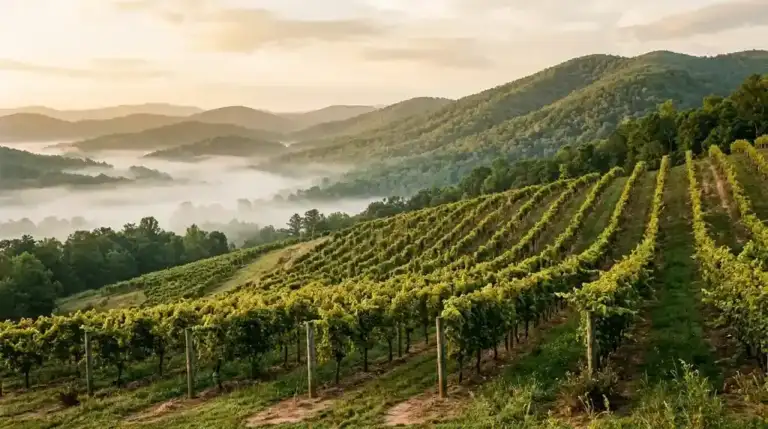
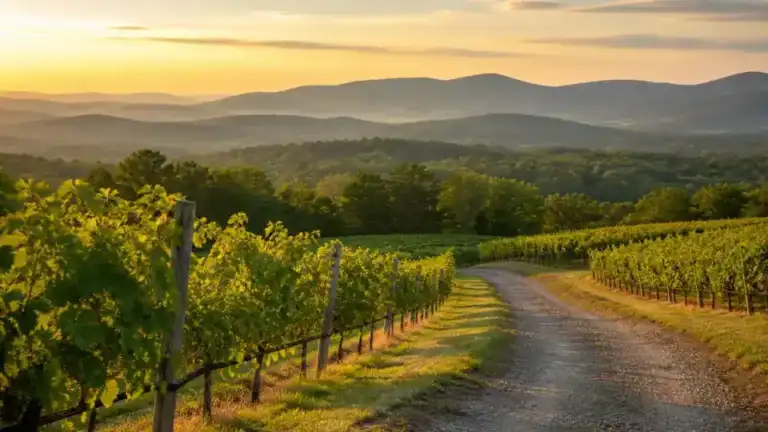
If gold defined Dahlonega’s first chapter, wine wrote its second. The town sits at the center of the Dahlonega Plateau American Viticultural Area (AVA), established in 2018, which covers approximately 133 square miles of Lumpkin and White counties. The plateau’s gently rolling terrain-with an average elevation of approximately 1,554 feet, according to the federal rule that established the AVA-combined with well-drained sandy loam soils creates conditions remarkably similar to European wine regions, but with a distinctly Southern twist.
What makes Dahlonega wine country special isn’t just the terroir-it’s the concentration. Within a short drive of the town square, you’ll find vineyards and tasting rooms, each with its own personality. Some specialize in European varieties adapted to Georgia soils; others experiment with hybrids developed specifically for the humid Southern climate. The collective effect is a wine destination that rivals regions twice its size, with none of the pretension.
The wine culture transformed Dahlonega’s economy. Where mining boomtowns died when resources played out, Dahlonega evolved. Visitors who came for history now return for wine tours, vineyard dinners, and wine-release celebrations. The grapes layered over the gold rush, creating a town with two complementary reasons to visit.
Vineyard density: When the Dahlonega Plateau AVA was established in 2018, the federal rule noted that the petition counted 7 wineries and 8 commercial vineyards within its boundaries. They sit close enough together to make a wine-trail day easy to plan. Here, you can visit several vineyards before lunch and still have time for the square.
A Town Square That Anchors It All
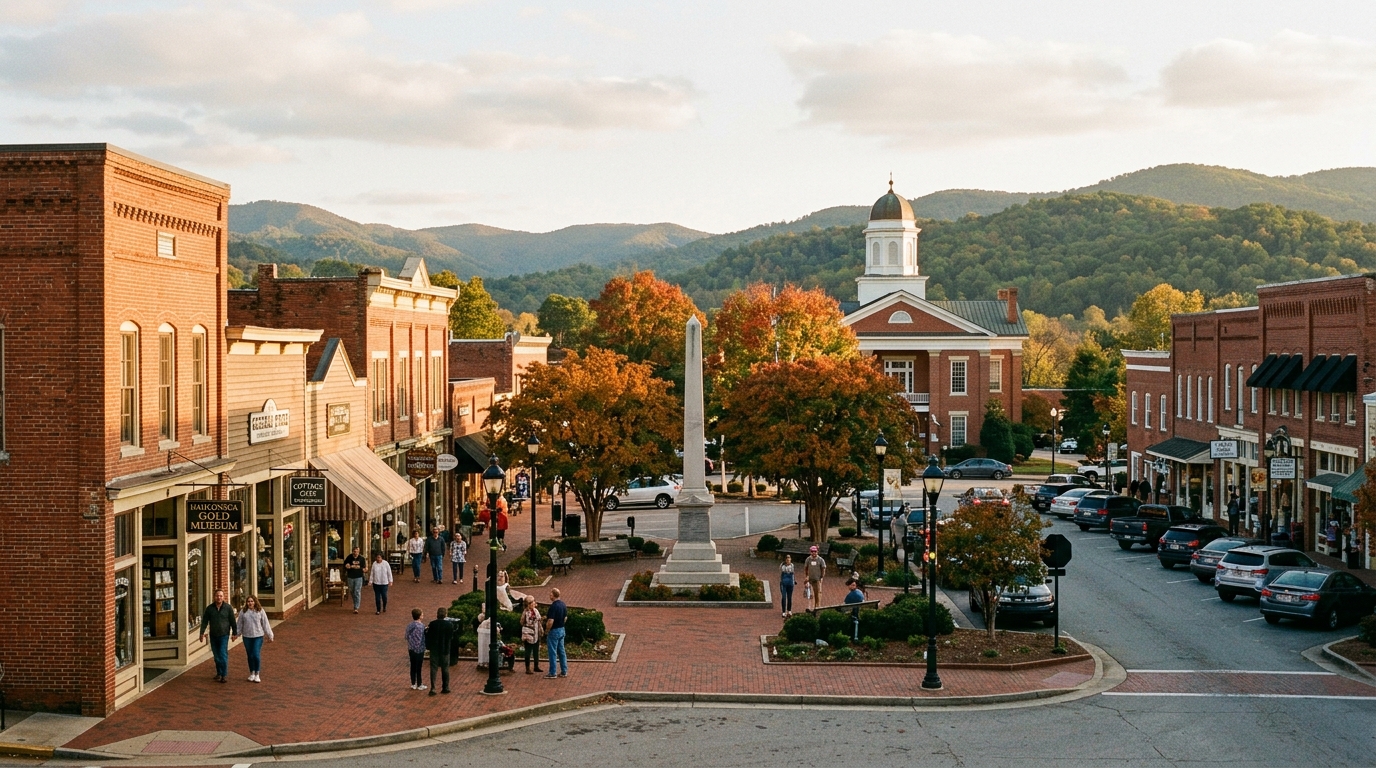
The physical heart of Dahlonega is the courthouse square-a brick-paved, tree-lined gathering place that would feel at home in a Norman Rockwell painting, were it not for the Appalachian ridges visible from every side. The 1836 Lumpkin County Courthouse, now the Dahlonega Gold Museum and one of the oldest courthouse buildings in Georgia, anchors the square, but it’s the life around it that defines the space.
On any given weekend, the square hosts farmers’ markets, live music, car shows, and festivals that spill onto the surrounding streets. Restaurants with sidewalk dining occupy historic storefronts. Specialty shops-antiques, crafts, clothing-line the perimeter. What’s remarkable isn’t the variety but the consistency: year-round, the square serves as Dahlonega’s public living room, the place where locals meet and visitors experience the town’s personality directly.
Some residents arrive because a business does. Owners planning a shop, an office, or a storefront usually start with Gold Peach commercial real estate in North Georgia before choosing the house around it.
The square also functions as Dahlonega’s outdoor museum. Historical markers detail the gold rush, the mint, and the Cherokee history that predates both. The architecture-late 19th-century commercial buildings with pressed-metal facades, early 20th-century brick banks, and the courthouse itself-documents the town’s evolution from mining camp to county seat to tourist destination. Among North Georgia mountain towns, Dahlonega’s preservation of its commercial core is exceptional, largely because the town never faced the pressure to modernize that faster-growing suburbs did.
The walking difference: You can experience Dahlonega’s character on foot without once needing a car. Park on the square (or in the nearby free lot), and everything unfolds within a few blocks: shops, restaurants, tasting rooms within walking distance, historic buildings, and public spaces. This walkability-rare in car-dependent Georgia-creates the unhurried pace visitors notice immediately.
The Mountain-Rimmed Setting
Dahlonega sits where the Piedmont meets the Appalachian foothills-an elevation change that defines both the climate and the character. The town sits high enough in the foothills to experience four distinct seasons, including winter snows that surprise flatlanders expecting Georgia to be subtropical. Summer evenings cool down enough for porches and wine tastings outdoors. Fall colors rival anything in New England, though the palette shifts toward bronze and gold rather than neon red.
This isn’t dramatic mountain scenery-no jagged Rockies or Smokies. The southern Appalachians are older, softer, rolling foothills that feel more like deep folds in the earth than vertical walls. Ridges are visible from every street, forested slopes change color with the seasons, and foggy valleys burn off by noon. The landscape feels like a participant in daily life.
The elevation and surrounding mountains also create a microclimate that enables the wine industry. The soils-well-drained sandy loam over granite parent material-naturally limit vine vigor, which produces concentrated fruit. The slope of the land allows cold air to drain away from vineyards, reducing frost risk. The combination isn’t accidental: winegrowers chose this location precisely because the mountains create conditions where European grape varieties can thrive in a humid Southern climate.
A College Town Without the Complications
North Georgia College & State University (now the University of North Georgia) has called Dahlonega home since 1873, giving the town an intellectual backbone that many mountain communities lack. The presence of a state military college-The Corps of Cadets trains on campus, uniforms visible in town-adds a layer of civic pride and tradition. But unlike many college towns, Dahlonega doesn’t feel dominated by student culture or seasonal population swings.
The university integrates into town rather than overtaking it. Cadets shop at the same stores as retirees; faculty and staff live in the same neighborhoods as winemakers and artists. The university hosts cultural events-lectures, performances, exhibitions-that the community attends, blurring the line between campus and town. What results is a place with the benefits of a college town-lifelong learning, cultural amenities, stable employment-without the drawbacks.
The Three-Strand Identity
What makes Dahlonega special isn’t any single thing-it’s how these strands braid together. The gold rush provides deep roots and historic authenticity. Wine country gives it contemporary relevance and economic vitality. The mountain setting creates both physical beauty and agricultural possibility. The town square is the gathering place where all these elements converge. The university provides continuity and institutional memory.
Other North Georgia towns have some of these elements-Blue Ridge has the scenery and tourism, Helen has the thematic identity-but Dahlonega combines them in a way that feels organic rather than manufactured. You’re not choosing between history and wine culture, between scenery and walkability, between small-town charm and intellectual life. You get all of it, layered over each other, the way a place that has evolved slowly over two centuries should.
What That Means for Visitors
If you visit Dahlonega expecting a single-attraction town-a mine tour and lunch-you’ll miss the point. The specialness lives in the intersections: walking from a wine tasting to the gold museum, hiking a forest trail in the morning and browsing the square in the afternoon, watching the sunset from a vineyard with mountains in every direction. The rhythm of a Dahlonega day isn’t about checking boxes but about experiencing how these different pieces fit together.
For people considering North Georgia as a place to live, Dahlonega offers something rarer than scenery: community. The town is large enough to support diverse businesses and services but small enough that you recognize faces at the farmers’ market. The university provides cultural events year-round. The wine industry brings visitors from across the region, creating a steady stream of new energy without overwhelming local life. The mountain setting offers outdoor recreation-hiking, fishing, scenic drives-that doesn’t disappear when the weather turns.
What makes Dahlonega, Georgia special? The answer is both specific and universal: a particular history, a particular landscape, a particular economy, woven together into a place that feels distinctive without self-conscious branding, historic without being a museum, alive without sacrificing character. It’s a North Georgia mountain town that figured out how to carry its past into its future without losing either.
Frequently Asked Questions
What is Dahlonega Georgia best known for?
Dahlonega is best known for three things: America’s first major gold rush (1828, predating California by twenty years), the Dahlonega Plateau AVA wine region with vineyards a short drive from the town square, and the historic courthouse square that is the physical and cultural heart of Lumpkin County. The combination of gold-rush history, wine culture, and mountain-town charm makes it distinctive among North Georgia communities.
Is Dahlonega worth visiting?
Yes-Dahlonega rewards both day-trippers and weekend visitors. The town square offers shopping, dining, and historic architecture within walkable distance. Wine enthusiasts can visit multiple vineyards in a single afternoon. History buffs can explore gold-rush sites, the former mint building, and historical markers. The mountain setting provides outdoor recreation year-round. What makes it worth visiting is the combination: you’re not choosing between activities, but experiencing how they layer over each other in a compact, walkable area.
What does the name Dahlonega mean?
The name “Dahlonega” derives from the Cherokee word talonega, meaning “yellow” or “golden.” The Cherokee referred to the region as the yellow place because of gold deposits in the area long before European Americans discovered gold in 1828. The anglicized spelling became official when the town was incorporated as the Lumpkin County seat in 1833.
How many wineries are near Dahlonega?
The federal rule that established the Dahlonega Plateau AVA in 2018 notes that the petition counted 7 wineries and 8 commercial vineyards within the area, so check current winery listings before planning a tasting day. The vineyards sit close enough together that visitors can taste at several in a single day. The AVA covers approximately 133 square miles in Lumpkin and White counties.
What is the elevation of Dahlonega?
Dahlonega sits where the Georgia Piedmont meets the Appalachian foothills; the federal rule that established the Dahlonega Plateau AVA puts the plateau’s average elevation at approximately 1,554 feet above sea level. This elevation creates four distinct seasons (including occasional winter snow), cooler summer evenings than lower elevations, and fall foliage that rivals northeastern states. The surrounding ridgelines create visible mountain scenery from the town square.
When was gold discovered in Dahlonega?
Gold turned up around Dahlonega in 1828-29; one popular account credits Benjamin Parks with a find west of the Chestatee River in 1828. The discovery triggered America’s first major gold rush, about twenty years before gold was found in California in 1848. By late 1829, thousands of prospectors had flooded into the area, leading to the establishment of Dahlonega as the Lumpkin County seat in 1833 and the opening of a U.S. branch mint in 1838. The mint produced gold coins until 1861.
What is there to do in downtown Dahlonega?
Downtown Dahlonega centers on the courthouse square, which offers shopping (antiques, crafts, clothing), dining (restaurants with sidewalk seating), and historic architecture within a walkable area. The square hosts farmers’ markets, live music, car shows, and festivals throughout the year. Historical markers detail the gold rush and local history. Several tasting rooms are within walking distance. The entire downtown experience unfolds on foot-no car required once you’ve parked.
Behind those storefronts sits a small but active commercial property market. Commercial real estate in Dahlonega is handled by the brokerage’s dedicated commercial desk.
Does Dahlonega have a college?
Yes-Dahlonega is home to the University of North Georgia (formerly North Georgia College & State University), founded in 1873. The university hosts The Corps of Cadets, a state military training program, and is significant employer and cultural anchor for the town. The presence of the college creates intellectual and cultural amenities unusual for a mountain community of Dahlonega’s size, while integrating into rather than dominating local life.
What makes Dahlonega different from other North Georgia towns?
Dahlonega’s distinctive combination-gold-rush history predating California, wine-country density rivaling regions twice its size, a preserved courthouse square serving as public gathering space, and a university providing institutional continuity-creates a layered identity that most mountain towns lack. Other North Georgia communities have individual elements (scenery, tourism, historic architecture), but Dahlonega weaves them together into an experience where history, wine, scenery, and small-town life reinforce rather than compete with each other.
Is Dahlonega a good place to live?
Dahlonega appeals to people seeking small-town mountain life with cultural amenities and economic diversity. The town supports year-round residents (not just seasonal tourism), offers university events and wine-industry vitality, provides outdoor recreation in the surrounding mountains, and maintains a walkable downtown square. Trade-offs include fewer job options than metro Atlanta (though remote work has reduced this constraint), limited shopping compared to suburban areas, and winding mountain roads that complicate winter commuting. What residents value is the quality of life: community, scenery, and pace.
Can you still pan for gold in Dahlonega?
Recreational gold panning continues in the Dahlonega area, primarily through commercial operations that offer equipment and instruction. Consolidated Gold Mine and Crisson Gold Mine provide tourist experiences where visitors can pan for gold and learn about mining history. However, these are educational and recreational activities, not commercial mining operations. Anyone considering modern mineral extraction should consult current federal, state, and local regulations-permits, environmental restrictions, and land-use rules apply, and practices acceptable in the 19th century may not be legal today.