Quick answer (TL;DR)
Dahlonega began as a prospectors’ camp when gold turned up in the North Georgia mountains around 1828. A branch of the U.S. Mint opened there in 1838. The Civil War closed the mint in 1861, and the town contracted. It came back slowly as a county seat and college community, and eventually settled into what it is now: a mountain destination that keeps its history visible in the courthouse square.
Dahlonega’s courthouse square sat in roughly the same location through the gold rush, through the decades after the mint closed, and through the years the university settled in. The layers accumulated. Most of them are still visible.
The town gold built
The mountains north of Atlanta were Cherokee territory in the early 1820s, remote and heavily forested. Settlers pushing up from the Georgia Piedmont had no particular reason to press into them. That changed around 1828, when gold turned up in the streams cutting through the North Georgia foothills. People came fast, in numbers the territory had never seen.
What grew around those early strikes was not a planned town. It started as a camp, then a cluster of rough structures, then something more permanent as it became clear the gold was real and the work would take years rather than months. Lumpkin County was organized from the former Cherokee territory in 1832. Dahlonega became its county seat.
The gold coming out of Lumpkin County was substantial enough to attract federal attention. Congress authorized a branch of the U.S. Mint, and it opened in 1838 on the site where UNG’s Price Memorial Hall now stands. For the next two decades, raw gold from the mountains was processed there into coins bearing the “D” mint mark. To understand what drove those years, Dahlonega’s gold rush story is the place to start.
Around 1828
Gold found in North Georgia streams. The first significant gold rush in U.S. history, about two decades before the California rush that followed the 1848 discovery.
Lumpkin County, 1832
Organized from former Cherokee territory with Dahlonega as its county seat. The legal structure that gave the gold camp a future beyond the rush itself.
1838: the Mint opens
Congress authorized a branch mint at Dahlonega. It struck gold coins with the “D” mint mark for more than two decades, until the Civil War ended its operation.
After the mint closed
The mint stopped striking coins in 1861 when Georgia seceded and Confederate forces took control of federal properties. It never reopened. The building eventually found its way into what became the University of North Georgia, and the story of what sits on that site now connects to a thread that runs all the way to Atlanta: the Georgia State Capitol dome wears Dahlonega gold, laid there in a 1958 ceremony that made the connection deliberate and public.
When the mint went quiet, Dahlonega contracted. The population that had gathered to work the gold fields drifted elsewhere. The town held on as a county seat, the courthouse still standing and the square still commercial, but quieter than it had been in decades. The gold that had drawn everyone there was worked out enough that mass extraction no longer made sense.
What preserved the town’s physical character was its isolation. No railroad came through to bring industrial-era redevelopment. The square that had organized itself around the gold rush sat largely undisturbed through the late nineteenth century, which is why so much of it is still recognizable today.
What closed the Dahlonega Branch Mint? The Civil War. When Georgia seceded in 1861, Confederate forces took control of federal properties throughout the state. The Dahlonega mint ceased operations and was never reopened as a federal facility. The building later became part of what became the University of North Georgia campus.
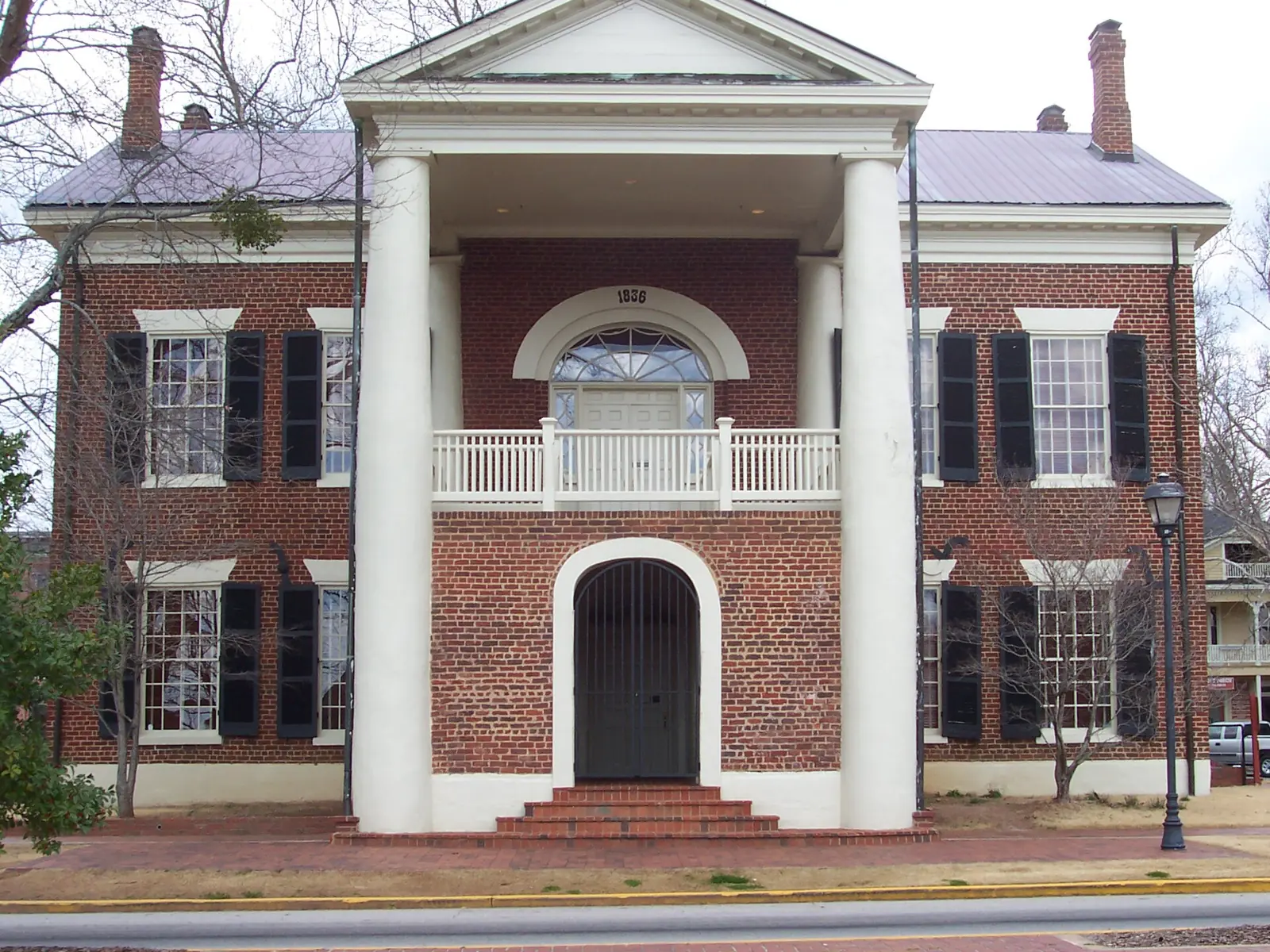
The Dahlonega Gold Museum is housed in the original 1836 Lumpkin County Courthouse, which predates the mint’s 1838 opening by two years. It is operated by the Georgia Department of Natural Resources. Confirm current hours before planning a visit.
A university settles in
The institution that became the University of North Georgia was established in 1873 on the former mint grounds. A college changes the shape of a small town. Faculty and students arrived on a semester calendar rather than a seasonal one. Shops, restaurants, and housing followed in the gradual way that small-town commerce fills in around a stable population, building incrementally rather than in a rush.
The campus’s most visible piece is Price Memorial Hall, whose bell tower carries its own small gold dome, gilded with Lumpkin County gold. The institution built on the mint site acknowledges what that ground used to be. The dome is visible from the town square, which means you can stand at one end of Dahlonega’s history and see the other from a reasonable distance.
Two centuries separate the gold camp from the present-day square, and the square looks like it remembers most of them.
The university stayed relatively small through most of the twentieth century, and that worked in the town’s favor. The courthouse square was never overwhelmed by the kind of growth that strips older commercial districts of what made them worth visiting in the first place.
The square as a living record
The Gold Museum anchors the north end of the square, inside the original 1836 courthouse. Around it: brick storefronts representing several generations of commercial construction, covered sidewalks, and a human-scaled layout where everything was sized for foot traffic. Nothing is grandiose. All of it is usable.
The density of historical association is what separates Dahlonega’s square from similar squares across the rural South. The ground under every block has a gold rush connection. The museum building is the courthouse where Lumpkin County’s business was conducted while the mint was active two blocks away. Stand at the right corner and you can see both sites in a single glance.
The physical coherence of the square draws visitors. It also draws people who want to stay. Understanding what makes Dahlonega different from other North Georgia towns starts at the square, but it does not stop there.
Dahlonega now
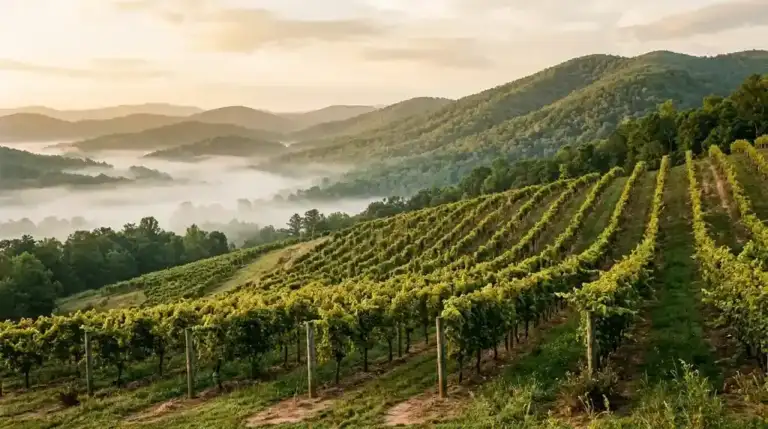
The wine country piece arrived in stages. How Dahlonega became wine country is a separate story, rooted in the granite soils and elevation of the Blue Ridge foothills, but the Dahlonega Plateau American Viticultural Area was formally established in 2018. The designation brought a different kind of visitor: someone who came for tasting rooms and sometimes began asking what a place in the hills might cost.
The combination Dahlonega presents is not common for a community of its size. A documented gold rush heritage, a working university on the original federal mint site, a preserved courthouse square, and a recognized wine appellation do not usually come together in the same few square miles. Most places in these mountains have one of those things, maybe two.
The buyer attention that has followed reflects something real about the place. The character was not manufactured for tourism purposes. It was there before the visitors arrived.
| Feature | Then (1828-1861) | Now |
|---|---|---|
| Primary economy | Gold mining and federal mint | Wine, mountain tourism, university, real estate |
| Federal presence | U.S. Branch Mint (1838-1861) | University of North Georgia (est. 1873) |
| Main public building | Lumpkin County Courthouse (1836) | Same building, now houses the Dahlonega Gold Museum |
| Regional recognition | First U.S. gold rush, federal mint town | Dahlonega Plateau AVA (2018), mountain destination |
| Distance from Atlanta | Remote; rough mountain roads | North of Atlanta; drive time varies with traffic |
Is Dahlonega still growing in terms of interest? In visitor attention and buyer activity, yes. The wine appellation, the mountain access from Atlanta, and the town’s documented history have all drawn more attention in recent years. The pace is nothing like a gold rush, but the direction has been consistent.
Dahlonega’s growing profile has changed buyer demand in the area. Conditions in specific price ranges and property types can shift quickly. If you are researching a purchase in or around Dahlonega, a conversation with a local specialist will tell you more than any online estimate.
Frequently Asked Questions
When was Dahlonega founded?
Dahlonega developed as a settlement in the late 1820s following gold discoveries in the North Georgia foothills. Lumpkin County was organized in 1832, with Dahlonega as its county seat. The Dahlonega Branch Mint opened in 1838 on the site now occupied by UNG’s Price Memorial Hall.
Why did the gold rush happen in North Georgia specifically?
The geology of the North Georgia foothills produced placer gold in the streams cutting through the Blue Ridge foothills. These deposits were accessible with basic tools. Lumpkin County’s location, where gold-bearing streams were numerous and relatively close to the surface, made it the center of the rush.
What was the Dahlonega Branch Mint?
The Dahlonega Branch Mint was a federal facility opened in 1838 to process raw Lumpkin County gold into U.S. coins. It struck quarter-eagles, half-eagles, and eagles bearing a “D” mint mark. The mint operated until 1861, when the Civil War brought its function as a federal institution to an end.
What happened to Dahlonega after the mint closed?
The mint closed in 1861 when Georgia seceded. The town contracted from its boom-era size but continued as a county seat. The courthouse square remained largely intact. The mint building was later absorbed into what became the University of North Georgia, established on the same grounds in 1873.
Is there still gold in Dahlonega?
Gold can still be found in streams around Dahlonega, though in quantities far below what drove the nineteenth-century rush. Several operations in the area offer gold-panning experiences where visitors can find genuine flakes. Confirm current hours with the operator before planning a visit.
What is the Dahlonega Gold Museum?
The Dahlonega Gold Museum is a state historic site housed in the original 1836 Lumpkin County Courthouse on the town square. It covers the history of the North Georgia gold rush through artifacts and exhibits. The Georgia Department of Natural Resources operates it.
What is the University of North Georgia?
The University of North Georgia is a public university headquartered in Dahlonega, established in 1873 as North Georgia Agricultural College on the site of the former Dahlonega Branch Mint. It has grown into a multi-campus institution and remains central to the town’s daily character.
When did Dahlonega become known for wine?
The Dahlonega Plateau American Viticultural Area was formally established in 2018, giving North Georgia wine country a recognized appellation. Vineyards in the area had been operating for years before the formal designation, but the AVA brought wider national attention to the region.
What makes Dahlonega different from other North Georgia mountain towns?
Few small mountain towns have a documented gold rush heritage, an active university on the original federal mint site, a preserved courthouse square, and a recognized wine appellation all within the same few square miles. Dahlonega does. That concentration of history alongside present-day character is genuinely unusual.
How far is Dahlonega from Atlanta?
Dahlonega sits north of Atlanta, and the drive depends on your starting point, route, and traffic. Achasta’s club site describes Dahlonega as just an hour away from Atlanta. It is a common day trip from metro Atlanta and a practical gateway to the North Georgia mountains.
What county is Dahlonega in?
Dahlonega is the county seat of Lumpkin County, Georgia. Lumpkin County is in the southern Appalachian foothills of North Georgia, bordered by Dawson, White, Hall, and Union counties.
Is Dahlonega a good place to live or retire?
Dahlonega combines small-town scale, mountain access, college town energy, and proximity to Atlanta in a way that appeals to buyers at various life stages. Whether it fits a specific situation depends on priorities around commute, property type, and community size. A local conversation is the most practical starting point.
Who handles real estate in the Dahlonega area?
Gold Peach Realty is the local brokerage serving Lumpkin County and the surrounding North Georgia mountain communities, with a focus on residential, mountain, and rural properties throughout the region.
Looking for a place in Dahlonega?
The mountains that drew prospectors in 1828 draw buyers today for different reasons. Local knowledge in Lumpkin County real estate makes the difference between a search and a decision.
See current Dahlonega, North Georgia listings at Gold Peach Realty
Photo credits: Dahlonega Gold Museum (1836 courthouse) — HowardSF at English Wikipedia, CC BY-SA 3.0, via Wikimedia Commons.